Хуйловська чістка Сєрґєй Марков каже, що кацапи не погодяться на умови Заходу, навіть якщо це буде варіант “фінляндизації“ України - тобто Україна без НАТО і Євросоюзу в кацапському розумінні.
Головне завдання Москваи - зміна влади в Україні на таку, яка погодиться з усім, що скаже Хуйло.
Особливо занепкоєна Орда новою Чорноморсько-Балтійською Ініціативою, яка до речі погодилася на присутність у ній представника Орди.
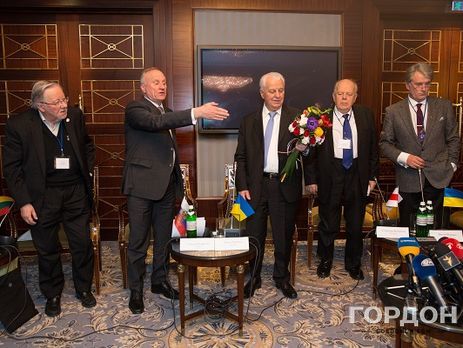
At the launch of the International Center for Baltic-Black Sea Research and Consensus in Kyiv, Ukraine on December 1, 2016 (L-R): Vytautas Landbergis (Chairman of the Seimas of Lithuania (1992, 1996-2000), Petru Lucinschi (president of Moldova (1996-2001 ), Leonid Kravchuk (President of Ukraine (1991-1994), Stanislav Shushkevich (Chairman of the Supreme Council of Belarus (1991-1994), and Viktor Yushchenko (president of Ukraine (2005-2010). Not shown: Lech Walesa (President of Poland (1990-1995), Valdis Zatlers (president of Latvia (2007- 2011), Leonid Kuchma (President of Ukraine (1994-2004), Arnold Ruutel (President of Estonia (2001-2006), and the representative of Russia Gennady Burbulis (Russia, Secretary of State (1991-1992). Photo: gordonua.com
http://euromaidanpress.com/2016/12/06/moscow-analyst-the-kremlin-wont-accept-finlandization-of-ukraine-euromaidan-press/Markov’s remarks only add to the importance of three other declarations this past week:
The first is Ukrainian President Petro Poroshenko’s statement that “Ukraine is now fighting to bury the Soviet Union in the heads of certain people” because while it has died officially, it hasn’t died in the minds of many and Moscow continues to view Ukraine as “a colony.”
The second is Ukrainian commentator Vitaly Portnikov’s conclusion that “no one,” including pro-Putin politicians in Europe, “will recognize Crimea” as part of the Russian Federation because to do so would undermine the international system of which they are a part. And despite Moscow’s continuing assertions that sanctions against it will soon be lifted, Portnikov adds, the sanctions are still in place, although they may be lifted eventually. But they are already playing an essential role and, as long as they remain, will continue to do so because, even when they are lifted, Russia will be that much further behind the West and thus weaker.
And the third is evidence that there is “new life” to the idea of a Baltic-Black Sea initiative now that the former leaders of the region have come together in the search for peace rather than a military alliance against Russia and have agreed to include in their number a Russian representative.
Irina Vereshchuk, the head of the International Center for Baltic-Black Sea Research and Consensus, tells Radio Liberty that including a Russian representative is not a retreat from the group’s purposes, which are to ensure security for all in the region, but a way for the countries “in between” to achieve exactly that.
“We are convinced that war, which could begin at any moment, would touch not only Ukraine. Today, Ukraine is suffering, but tomorrow it could be Poland and other countries, and the EU and NATO cannot ensure” that Russia will not “annex or occupy” even Latvia or Lithuania.
“Therefore,” Vereshchuk continues, “we have taken on ourselves responsibility and will try to develop common positions not against someone but for peace, for unity and for cooperation. This will be a platform on which it should be possible to listen to the opinion of this side. And this, I think, will be effective.”
“We have an action plan,” she says, “and we will propose it to the governments of the EU and the US, a plan of getting out of the global crisis which has arisen today.” She adds that Ukrainian President Poroshenko “supports our initiative and welcomes it” and says that her group will work to hold inter-parliamentary hearings in the next few weeks.


